Christine Laure, a women’s ready-to-wear brand established for decades in French city centers, has gone through a judicial recovery process that jeopardized its entire network. The commercial court of Dijon played a central role in this case, granting the group an extension to find a buyer and avoid liquidation. Today, the brand enters a new phase, but challenges remain numerous.
What the judicial procedure has changed for the Christine Laure network
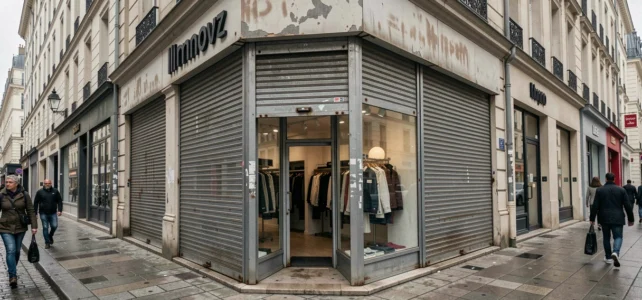
The placement in judicial recovery has led to the closure of several Christine Laure stores across France. This decision, far from being a mere accounting episode, resulted in job cuts and emptied some commercial locations in city centers.
The commercial court of Dijon extended the observation period by six months. This extension allowed the group to restructure its offering and seek a buyer capable of ensuring continuity. The brand has finally found a buyer, with the retention of the Dijon teams, which avoided the scenario of a complete liquidation.
When questioning the future of Christine Laure after the definitive closure of certain points of sale, the answer lies in this acquisition, but also in the strategic choices that follow.

Women’s ready-to-wear market: a context weighing on the recovery
The ready-to-wear crisis does not affect Christine Laure in isolation. The in-store revenue of clothing brands fell by 1.7% in 2025 according to sector panel data. At the same time, the share of e-commerce in clothing is growing every year, rising from about 21.7% in 2024 to a projection of 22.4% in 2025.
Why do these figures matter for Christine Laure? Because the brand has historically built its model on a network of physical boutiques, often located in shopping streets of medium-sized cities. However, foot traffic is declining, and the brand’s most loyal customers (women over 50) are also starting to turn to digital, although this shift is slower than among younger generations.
A physical model to rethink
Maintaining a dense network of boutiques represents a high fixed cost: rents, charges, personnel. When foot traffic decreases, each point of sale becomes more difficult to make profitable. Reviving Christine Laure without a digital repositioning would be going against the market trend.
The premium women’s ready-to-wear segment, on the other hand, is holding up better than the classic mid-range. This is a signal that could guide the buyer’s strategy: moving upmarket rather than seeking volume.
Acquisition of Christine Laure: concrete levers for survival
The acquisition validated by the commercial court of Dijon has allowed the retention of the teams at the Dijon headquarters. This is a starting point, but medium-term survival depends on several precise decisions.
- Reduction of the number of stores in favor of profitable points of sale, in high-traffic locations or in cities where the brand retains a loyal customer base, such as Gray where an installation in the city center has been announced.
- Development of an online sales channel capable of compensating for the loss of revenue due to closures. Without a performing e-commerce site, the brand loses contact with customers in areas where boutiques have closed.
- Upgrading and stylistic differentiation to stand out from low-cost brands and fast fashion giants, which capture an increasing share of the market.
- Emphasizing territorial anchoring and French know-how, a positioning that resonates with Christine Laure’s historical clientele and aligns with a promising trend in the premium market.

The trap of a dense physical network
You may have noticed that large fashion brands close dozens of stores each year, even when they are not in difficulty? This is because the cost of an oversized network eats into margins faster than the decline in revenue.
For Christine Laure, the buyer will have to balance local visibility and profitability. Keeping too many boutiques out of attachment to brand image would be a costly mistake. Better to have ten profitable stores than thirty that are losing money.
Ready-to-wear crisis in France: Christine Laure as a case study
The journey of Christine Laure illustrates a structural fragility shared by many mid-sized French brands. Caught between luxury brands, which attract high purchasing power customers, and fast fashion brands, which dominate through pricing and responsiveness, mid-range brands struggle to justify their positioning.
The judicial recovery of Christine Laure is not an accident. It is the result of a gradual mismatch between a business model designed for the 2000s and a market that has shifted towards digital and fine segmentation of customer bases.
What distinguishes the brands that succeed
Ready-to-wear brands that resist the crisis share some common traits: a strong brand identity, a performing digital channel, and a capacity to limit fixed costs. Christine Laure has the notoriety, but the other two pillars remain to be built or strengthened.
The brand has an asset that many struggling brands do not have: a loyal customer base, attached to a style and a story. The challenge for the buyer will be to transform this loyalty into recurring purchases, including online, without distorting what defines the brand’s identity.
The Christine Laure file remains open. The acquisition has removed the immediate risk of disappearance, but the profitability of the new perimeter is not yet secured. The coming months will reveal whether the buyer can transform a weakened brand into a label suited to the realities of the 2026 market.