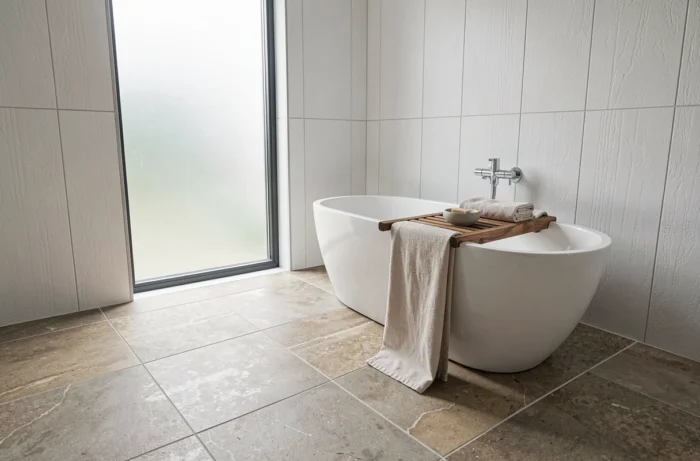
Bathroom tiling is not just a matter of aesthetics. Behind every tiling trend lies a trade-off between format, finish, installation constraints, and ease of maintenance. What truly differentiates the options available this year are the technical discrepancies between materials, particularly regarding slip resistance, joint management, and performance in large formats.
Comparison of Tile Finishes for Bathroom Floors
Several finishes compete for bathroom floors: matte, glossy, textured. Each has direct implications for daily use and safety, especially in a wet area like the shower.
| Finish | Barefoot Grip | Maintenance | Visual Effect |
|---|---|---|---|
| Matte | Good (class B or C according to standard EN 16165) | Less sensitive to water marks | Sober, contemporary |
| Glossy | Poor (class A, not well-suited for shower floors) | Visible limescale marks | Bright, enlarges the space |
| Textured | Very good (non-slip surface) | More demanding cleaning (relief) | Natural, stone or wood effect |
The key point to remember: grip must be evaluated barefoot, not with shoes on. Standard EN 16165 distinguishes several testing methods. A product sheet displaying a class A, B, or C rating for barefoot use provides a reliable indication for shower floors. A glossy tile rated A is suitable for walls, but rarely for the shower base.
To delve deeper into material and color combinations, the tiling trends on Madmoizl Déco detail several combinations suitable for both small and large surfaces.
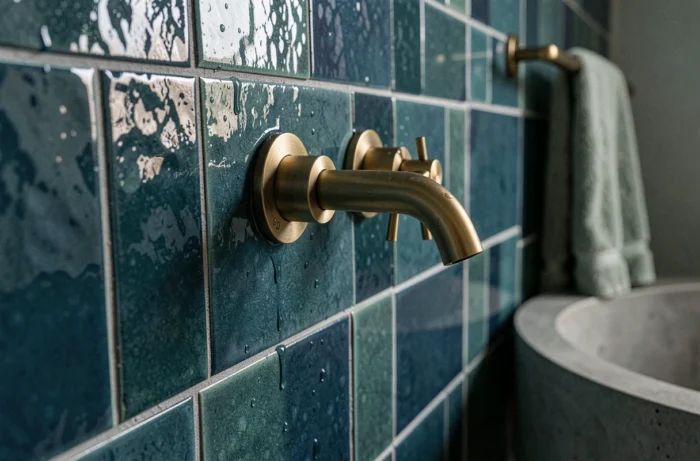
Large Format Porcelain Stoneware: Real Installation Constraints
Large format porcelain stoneware dominates showrooms. Its promise: reduce the number of joints to achieve a unified surface. In a spacious bathroom, the result is indeed spectacular.
The downside is technical. A large tile requires a perfectly flat substrate. The slightest flaw in flatness causes tilting or lips (misalignment between two adjacent tiles). The installer must work with double bonding, which increases labor costs.
The Specific Case of the Italian Shower
In an Italian shower, the floor must incorporate a slope towards the drain. A large format complicates this operation: the rigid slab does not follow the natural slope without multiple cuts. A smaller format, or a mosaic, facilitates the creation of the drainage slope while offering better grip due to the density of joints.
Choosing a large format for the walls and a smaller format for the shower base is a common compromise that combines aesthetics and functionality.
Waterproofing Under Tiles: The Invisible Parameter
Tiling trends highlight surface effects (stone, marble, wood), rarely what happens underneath. The glaze of a tile may be waterproof, but the joints and substrate are not without prior treatment.
In areas directly exposed to water splashes (shower walls, bathtub edges), a liquid waterproofing system (SEL) or a membrane must be applied before installation. Without this layer, water eventually migrates under the tiles, with consequences for the structure (mold, detachment).
- The liquid waterproofing system is applied with a roller on the raw substrate, including in corners, before any tile installation.
- Waterproofing strips reinforce singular points: floor-wall junctions, pipe passages, shower thresholds.
- The complete drying time of the SEL conditions the adhesion of the tiles: installing too early compromises the entire system.
This item represents a modest additional cost relative to the total bathroom budget, but its absence is the leading cause of incidents in wet areas.
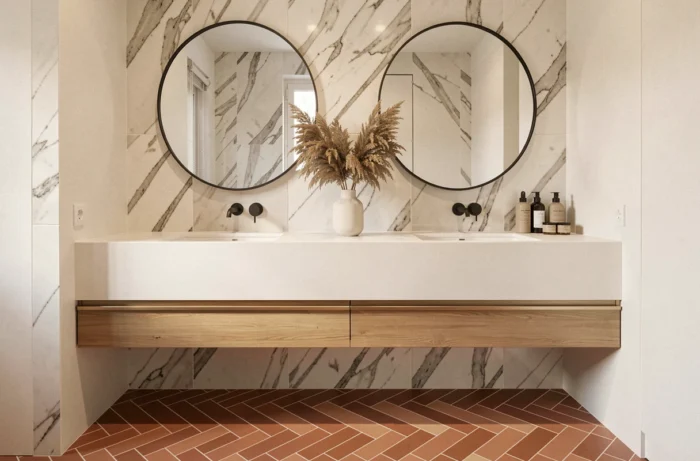
Epoxy or Cement Joints: A Maintenance Trade-off
The choice of joint is often relegated to the end of the project. Yet it conditions the visual durability of the tiling, especially with formats that multiply joint lines (mosaic, metro tiles, zellige).
- Epoxy joints are low porosity, stain and mold resistant. They retain their color over time, even in humid environments. Their implementation requires specific expertise as the mixture hardens quickly.
- Cement joints remain more common and less expensive. They absorb more moisture and require regular waterproofing treatment to avoid darkening.
- With a mosaic, the joint surface area is proportionally much higher than with a large format. The type of joint then becomes a determining factor for daily maintenance.
For a tiled shower in mosaic or small tiles, the additional cost of epoxy jointing is justified by the reduction in cleaning time over several years.
Stone Effect, Wood Effect: The Finishes Rising in Porcelain Stoneware
Porcelain stoneware imitating stone (travertine, limestone) and wood effect porcelain stoneware remain among the most sought-after styles this year. Manufacturers have refined the textures to the point of making tactile distinction difficult from the original material.
The advantage of porcelain stoneware over natural stone in the bathroom lies in its almost zero porosity. A porcelain stoneware does not require any waterproofing treatment, unlike natural travertine which must be regularly waterproofed to withstand water splashes and cleaning products.
The wood effect, in turn, allows for a warm tone without the constraints of solid parquet in a wet area. The wood effect porcelain stoneware planks can be installed on the floor as well as on the wall, with elongated formats that visually lengthen the space.
Bathroom tiling is chosen as much for its technical properties as for its appearance. Format, finish, underlying waterproofing, and type of joint form a whole, where each element influences the longevity of the result. A well-chosen tile on a poorly prepared substrate will not live up to its promises, regardless of the current trend.