
An effective gardening website relies on a well-thought-out structure, not on a stack of pages written over the seasons. Structuring the site map involves balancing informational content that attracts organic traffic with transactional pages that generate conversions. We will detail the architectural choices that make a difference on a gardening site, whether it is a showcase or an e-commerce site.
Structure by search intent rather than by botanical category
Classifying pages by plant family (perennials, shrubs, grasses) seems logical for a gardener. For Google and for the user, it is often a trap. The structure must reflect search intentions, not horticultural taxonomy.
A visitor rarely types “perennial plants.” They search for “perennial plants full sun clay soil” or “low-maintenance evergreen hedge.” The site map benefits from organizing pages around these combined queries: soil type, exposure, maintenance level, use (hedge, flower bed, vegetable garden, balcony).
We recommend crossing two axes in the main navigation: use (landscaping, maintenance, vegetable gardening, decoration) and constraints (soil type, climate, budget). This structure generates category pages that directly correspond to long-tail queries, without creating duplicate content. To see how a mature site organizes its sections and subsections, the sitemap page of Jardiner Facile provides a good overview of the possible granularity.
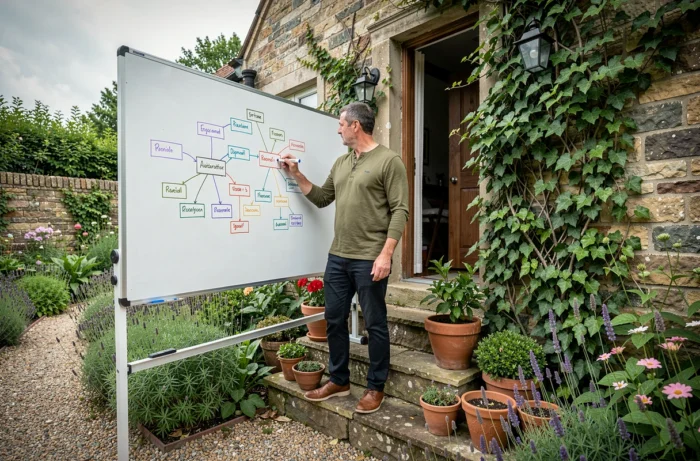
Separate free content and commercial pages in the gardening site map
The French gardening market shows a stark contrast between the high proportion of French people who garden and a tendency towards caution in purchases. This reality imposes a two-speed architecture.
Free supporting pages
Sowing calendars, disease diagnostics, seasonal maintenance guides: these contents attract regular and qualified traffic. They should exist in a distinct editorial branch (blog or advice space), with internal links to the corresponding product or service pages.
Transactional pages
Each product or service page must address a single purchase intent. A “hedge trimming” page does not mix the sale of pruning shears with maintenance services. The conversion funnel remains short: description, price or quote, call to action.
This clear separation allows for tracking two different metrics. Free content aims for time spent on the site and positioning on Google. Commercial pages aim for the conversion rate. Mixing the two on the same page dilutes both objectives.
Accessibility and EAA compliance: impact on the architecture of a gardening site
Since June 28, 2025, the European Accessibility Act (EAA) applies to e-commerce services, including plant catalogs and ordering tunnels. Showcase sites for gardeners that only present services without online sales do not automatically fall within this scope.
A site allowing the ordering of plants or services must integrate accessibility from the design of the structure, not as a fix after going live. Specifically, this concerns contact forms, shopping carts, search filters, and payment steps.
- Category filters (soil, exposure, season) must be keyboard navigable and compatible with screen readers
- Plant images require descriptive alt attributes integrated into the publication workflow, not added afterward
- The ordering tunnel must provide clear error messages and sufficient contrast at each step
Some microenterprises benefit from an exemption, but the regulatory trend is clear. Planning an accessible structure from the start is cheaper than overhauling an existing site.

Diagnostic logic in the internal linking of the site
Competitors organize their sites by content type: articles, plant sheets, service pages. We observe that a more effective angle is to structure the internal linking around a diagnostic logic.
The visitor arrives with a problem (“my tomatoes are turning yellow,” “moss in the lawn,” “soil too chalky”). The site map should include entry pages by symptom or constraint, which then guide towards solutions (suitable plant sheets, products, services).
This funnel approach works better than catalog navigation for two reasons. First, it corresponds to actual search behavior on Google: problem/solution queries generate more clicks than generic queries. Second, it increases the number of pages viewed per session, which sends a positive signal to search engines.
- Create “diagnostic” pages by theme: soil, pests, climate, seasonality
- Link each diagnosis to two or three solution pages via contextual links in the body text
- Use Search Console data to identify the most frequent problem/solution queries and create the missing pages
Technical sitemap and crawl depth for a gardening site
A gardening site quickly accumulates hundreds of pages: plant sheets, seasonal articles, regional variants. Without controlling the crawl depth, Google indexes only a fraction of the content.
We recommend limiting the depth to a maximum of three clicks between the homepage and any final page. Beyond that, the crawl budget gets dispersed. For a site exceeding a few hundred pages, a segmented XML sitemap by content type (articles, product sheets, category pages) speeds up indexing.
Outdated seasonal pages must be actively managed: 301 redirect to the updated version or canonical tag to the parent page. An article “vegetable garden calendar 2024” still indexed without an update harms the perceived freshness of the site by Google.
The plan of a gardening site is not a fixed document. It evolves each season as traffic data reveals the actual queries of users and the content catalog expands. The only structural mistake that is difficult to correct afterward remains a flat structure, without a clear hierarchy between pillar pages and satellite pages.