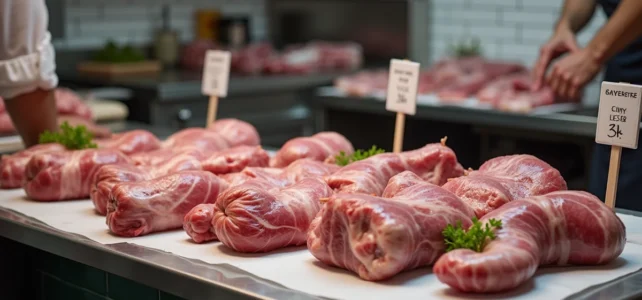
Sheep testicles are among the most delicate offal to preserve. Their high water content and extensive vascularization make them sensitive to temperature fluctuations, ice crystals, and bacterial growth. Freezing this piece requires a specific method, distinct from what one would apply to a leg or shoulder cut.
Vascularized tissue and freezing: why sheep testicles require special treatment
Lamb or sheep testicles consist of highly vascularized tissues, filled with blood and water. This composition makes them more similar to kidneys than to a classic muscle cut.
During freezing, the water contained in these tissues forms ice crystals. The larger these crystals are, the more they puncture the cell walls. Upon thawing, the result is an abundant purge and a loss of texture that is difficult to recover during cooking.
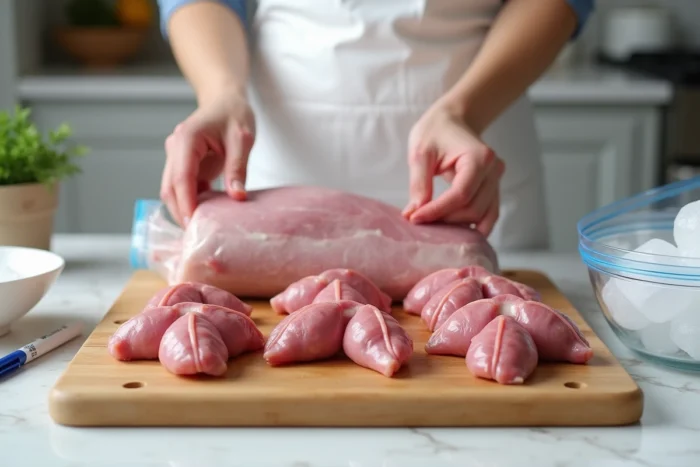
To limit this phenomenon, recent technical guides recommend not freezing offal in bulk, but in thin, well-spread portions. The goal is to reduce the time it takes for the temperature to drop at the center of the piece, which limits the size of the crystals. Following the advice from Matin Gourmand, this same logic of portioning before freezing is emphasized.
Storage duration of sheep testicles in the freezer
The storage duration varies depending on the packaging method. The table below summarizes the differences observed between the main methods.
| Packaging method | Recommended duration | Main risk |
|---|---|---|
| Standard freezing bag (manually removed air) | Several weeks to two months | Freezer burn, rancidity of fats |
| Vacuum packaging | Several months (significantly longer duration) | Limited risk if the cold remains constant |
| Aluminum foil alone | Several weeks at most | Insufficient protection, rapid oxidation |
The difference between a standard bag and vacuum packaging is significant. Vacuum packaging limits freezer burn and rancidity of the fats present in the offal, provided a constant temperature of -18 °C or below is maintained.
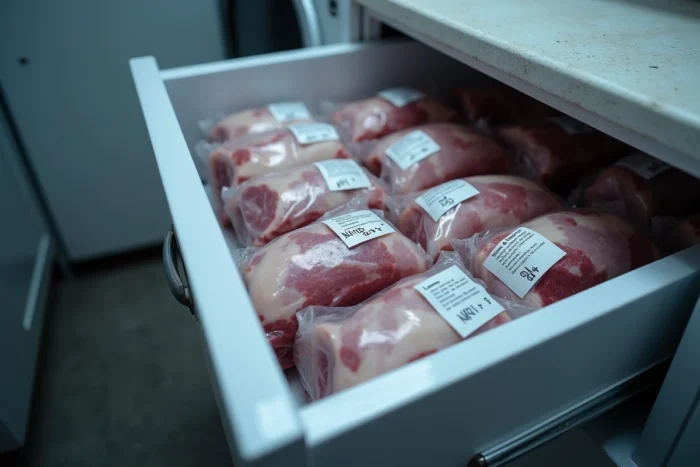
Artisanal butcheries are increasingly offering vacuum-packed testicles and sheep heads, precisely to meet this long-term preservation requirement. If you do not have a vacuum machine, remove as much air as possible from the freezing bag and double-wrap it.
Preparation before freezing: the steps that change the outcome
The final quality after thawing is determined before freezing. A few actions make the difference between usable offal in the kitchen and a soggy piece.
- Removing the outer membrane (the thin skin surrounding each testicle) facilitates both freezing and subsequent cooking. This membrane hardens in the cold and complicates peeling after thawing.
- Cutting into slices or uniformly sized portions allows for quick and even temperature reduction. Pieces of different sizes in the same bag create unevenly frozen areas.
- Carefully blotting each piece with absorbent paper before packaging reduces the amount of free water that will form crystals. Less water on the surface means less frost in the bag.
- Labeling each portion with the freezing date remains the only reliable way to adhere to the recommended storage duration.
A detail often overlooked: never place still-warm portions in the freezer. If the testicles have been blanched or precooked, they must be allowed to cool completely in the refrigerator before being packaged and frozen.
Thawing sheep testicles: managing purge and texture
Slow thawing in the refrigerator remains the only safe method for water-rich offal. Allow a full night for standard-sized portions.
Using the microwave or thawing in warm water causes thermal shock that increases purge. The tissue then loses some of its tenderness, and cooking will not recover this deficit.
After thawing, a brief marinade or light brining partially compensates for the loss of texture. Seasoning penetrates better into tissue that has released water, allowing for a taste result close to that of fresh product.
Refreezing: a strict limit
Food safety recommendations emphasize a non-negotiable point for offal: any refreezing after thawing is to be avoided. Offal is more sensitive to microbial development than muscle cuts. A thawed sheep testicle must be cooked within 24 hours and consumed without delay.
This rule, echoed by several awareness campaigns (notably around Eid meat), applies with even more rigor as testicles already lose organoleptic quality with each temperature variation.
Raw or cooked freezing: what choice for sheep testicles
Both options are viable, but the results differ.
Raw freezing better preserves the original texture, provided that the preparation (peeling, cutting, packaging) is rigorous. In contrast, freezing after light precooking (quick blanching) stabilizes the piece and reduces the bacterial load before storage.
The most effective compromise for later use in sautéing or frying: blanch the testicles for a few minutes in salted water, cool in the refrigerator, then vacuum package before freezing. This method combines food safety and texture preservation without complicating preparation on the day of final cooking.
Freezing sheep testicles tolerates little approximation. Fine portioning, vacuum packaging when possible, strict maintenance of cold, and slow thawing in the refrigerator are the four parameters that determine the quality of the result on the plate.