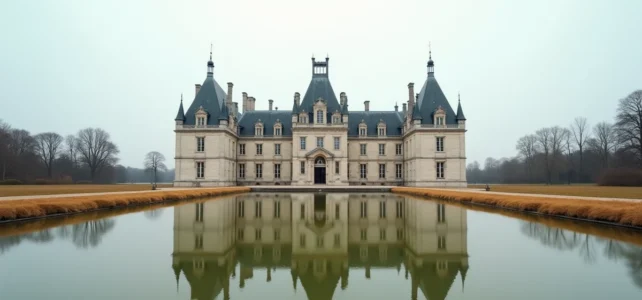
Assigning a market value to the Château de Chambord is an exercise without equivalent in the French real estate market. The monument, owned by the state for centuries, has never been put up for sale and does not appear in any transaction database. Estimating its value therefore requires crossing several frameworks: reconstruction costs, generated income, heritage weight, and conservation expenses. The following analysis confronts these approaches to determine what Chambord is “worth” in 2026.
Reconstruction Costs and Comparison with Castles Sold in France
The most intuitive method is to estimate what it would cost to construct an equivalent building today. On Quora, several estimates converge towards a floor of at least 100 million euros, due to the price of stonemasons and the architectural complexity of the Renaissance.
A commonly cited point of comparison: the Château Louis XIV, built in the 2000s in Île-de-France with high-end materials, sold for nearly 300 million euros. This modern castle is, however, much smaller than Chambord and lacks both its antiquity and its UNESCO classification.
| Criterion | Château Louis XIV (sold) | Château de Chambord (estimate) |
|---|---|---|
| Construction Period | 2000s | From 1519 |
| Price or Estimate | About 300 million euros | Theoretical exercise, no transaction |
| Heritage Classification | None | Historical monument (1840), UNESCO heritage |
| Owner | Private | French state |
| Domain Area | Several hectares | Several thousand hectares |
This table illustrates the gap between a luxury property negotiable on the market and a monument whose value exceeds any transactional logic. An estimate of the Château de Chambord on Partenariat Immo also offers a complementary framework to understand the parameters considered in this type of evaluation.
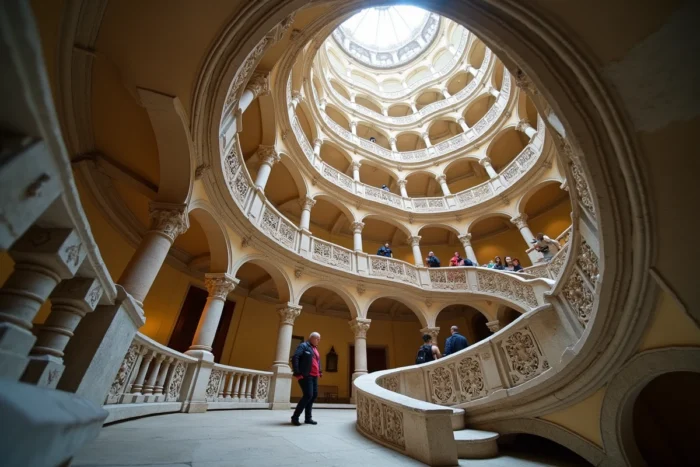
Chambord Monument in Peril: The 37 Million Euro Project
The value of a castle is not only measured by what it would bring in a sale. It is also reflected in what is spent to keep it standing. A report from the Court of Auditors, made public at the end of 2023, indicated that parts of the Château de Chambord were in a concerning state of health.
Since then, the situation has evolved. In 2026, a restoration project for the François Ier wing mobilizes an estimated budget of 37 million euros. This considerable amount for a single building gives an idea of the overall cost of maintaining a structure of this scale over several decades.
The Court of Auditors also expressed concern about the exponential expenses required for major heritage projects in France. Chambord concentrates these tensions: sustained tourism development since 2010, but the conservation of the monument sometimes relegated to the background.
Exceptional Tax Provision for Chambord in 2026
The state has introduced a specific tax exemption that distinguishes Chambord from all other French monuments. In 2026, donations for the restoration of the castle benefit from a 75% tax reduction rate, compared to 66% for individuals and 60% for businesses under the general framework of heritage patronage.
This increased rate is capped at 1,000 euros per donor and goes through a closed list of organizations:
- The National Domain of Chambord, direct manager of the site
- The Public Treasury and the National Monuments Center
- The Fondation de France and the Fondation du patrimoine
This measure classifies Chambord in the category of priority endangered monuments. It sends a political signal: the state recognizes that its own allocations are no longer sufficient to cover restoration needs. The symbolic value of the castle is thus doubled by a budgetary value, as each euro of donation generates a fiscal loss accepted by public authorities.
Heritage and Tourist Value of the Chambord Domain
The national domain of Chambord is not limited to the castle. It encompasses a walled hunting territory, one of the largest in Europe, with forests, agricultural land, and ancillary buildings. This land, if estimated at rural market prices in Loir-et-Cher, would already represent a very significant sum, without even considering the built structures.

On the revenue side, tourist attendance at the castle has notably increased since 2010. Chambord welcomes each year a number of visitors that places it among the most visited historical sites in France, behind Versailles and Mont-Saint-Michel. Ticket sales, space rentals, and merchandise generate a regular financial flow.
A new initiative could further change the situation: the Heritage Pass, announced for September 2026, offered at 100 euros and providing access to several major French monuments including Versailles, Chambord, and Fontainebleau. Its impact on attendance and revenue remains to be measured, but it confirms that Chambord is treated as a strategic asset of national heritage.
Why No Price Can Summarize the Value of the Château de Chambord
Any attempt at estimation encounters a fundamental obstacle: Chambord is inalienable. As a state-owned property classified as a historical monument and inscribed on the UNESCO World Heritage list, it cannot be sold. No potential buyer, no auction, no reference market.
Approaches based on reconstruction costs, tourist income flows, or comparisons with sales of private castles all yield orders of magnitude that are all beyond several hundred million euros. The 37 million euro project for a single wing, the exceptional tax provision, and the land of the domain confirm this scale.
The value of Chambord remains an object of analysis, not negotiation. The castle is worth what France is willing to spend to preserve it, and that amount continues to rise.