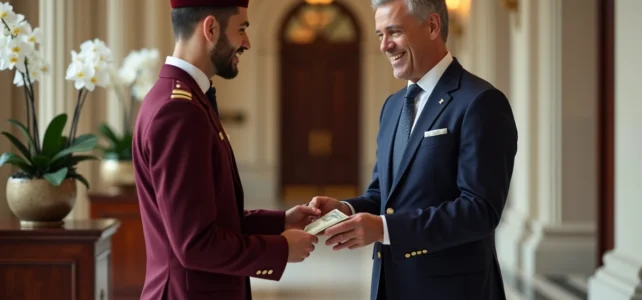
Tipping in luxury hospitality follows specific codes that vary according to the staff position, the destination, and the level of service provided. The amounts are not decided randomly: they reflect the salary structure of the establishment and the degree of personalization of the service received.
Weight of Tips in Hotel Staff Compensation
In palaces and five-star hotels, tips are not a trivial supplement. For porters, concierges, and head waiters, they constitute a structural part of their income. In certain destinations like Morocco, these gratuities can represent 30 to 60% of the base salary for servers in premium dining.
A palace concierge or head waiter can sometimes see their salary double in high season thanks to tips. This economic reality explains why luxury staff pay particular attention to the quality of individual service: gratuity is not a bonus, it is a pillar of their compensation.
We also observe a strong seasonality of tips in high-end establishments. During the tourist high season, the amounts received by staff increase significantly, while in low season, the drop in attendance directly affects their income. An informed traveler takes this into account: giving a generous tip off-season has a proportionally greater impact.
Understanding the issue of tipping in a luxury hotel requires knowledge of these mechanisms, which differ radically from those in a neighborhood restaurant or a taxi.
Tip Amount by Job in a Five-Star Hotel
Not all positions in contact with clients are tipped in the same way. The logic is based on two criteria: the duration of the interaction and the degree of personalization of the service provided.
Porter and Valet
The porter intervenes briefly but handles your personal belongings. We recommend giving per bag carried, rather than a total amount. The valet, on the other hand, receives their tip when returning the vehicle, not upon drop-off.
Concierge
The concierge is tipped based on the service provided, not the stay. A reservation at an ordinary restaurant does not justify the same amount as securing tickets for a sold-out show or organizing a complex private transfer. The more the request deviates from the standard, the higher the tip.
Housekeeper and Supervisor
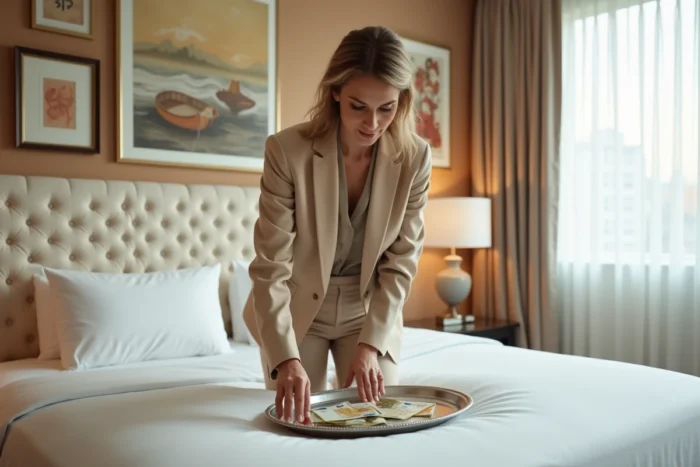
The room maintenance service is often overlooked. Leaving a daily amount on the nightstand or desk (with a note indicating that it is a tip) remains the most reliable practice. Waiting until the end of the stay to give a lump sum poses a problem: the room staff changes from day to day, and one person ends up receiving what should be distributed.
Room Service and Dining Staff
In hotel dining, the bill sometimes includes a line for “service” or “gratuity.” We systematically check this point before adding anything. If service is included, a modest additional amount is sufficient to express satisfaction. If nothing is mentioned, the local high-end dining customs apply.
Luxury Hotel Tipping in Europe, Asia, and North America
Conventions vary radically from one geographical area to another, and applying a single standard leads to costly mistakes (more in image than in money).
- In France and Italy, service is generally included in the bill. Tipping remains a gesture of satisfaction, not a social obligation. A few euros for the porter, a modest daily amount for room maintenance, and a one-time gratuity for the concierge cover common practice.
- In the United States and Canada, the tipping culture is structural. Not leaving a tip is perceived as a penalty. Staff expect to receive a systematic gratuity, even for brief interactions.
- In Southeast Asia and Japan, the situation reverses. In Japan, tipping can be seen as an offense. In Thailand or Vietnam, a small amount is welcome but not expected with the same intensity as in North America.
- In Gulf countries and Morocco, tips are expected and appreciated. The high tourist season amplifies this expectation, and staff adjust their efforts based on the reputation for generosity of the clientele.
Common Mistakes and Protocol for Giving Tips
The manner of giving is as important as the amount. We regularly observe travelers making blunders that negate the positive effect of their generosity.
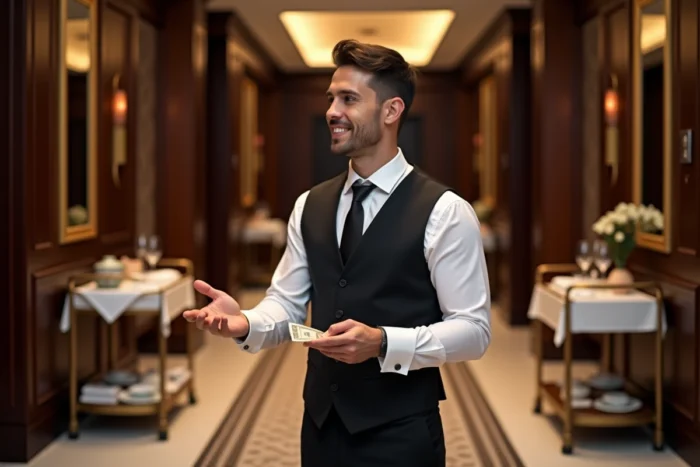
First mistake: giving the tip in front of other clients or ostentatiously. In luxury hospitality, discretion is a fundamental code. The tip should be given discreetly, by hand, often folded in the palm during a handshake or slipped into an envelope.
Second mistake: using only coins. In a palace, handing a handful of change to the concierge who just secured you a table at the city’s top restaurant sends a contradictory signal. Bills are the norm.
Third mistake: confusing tipping with negotiation. Promising a tip in exchange for an upgrade or preferential treatment puts the staff in an uncomfortable position. Gratuity rewards a service rendered; it does not buy it.
Last often-overlooked point: the local currency is always preferable. Giving dollars in a Parisian hotel or euros in a Thai resort forces the staff to deal with currency exchange, which reduces the actual value of the gesture.
Tipping in luxury hospitality remains an exercise in cultural understanding as much as in generosity. Adapting the amount to the position, the country, and the season, then taking care in the giving: these three parameters are enough to transform a simple gratuity into a mark of savoir-vivre recognized by the staff.