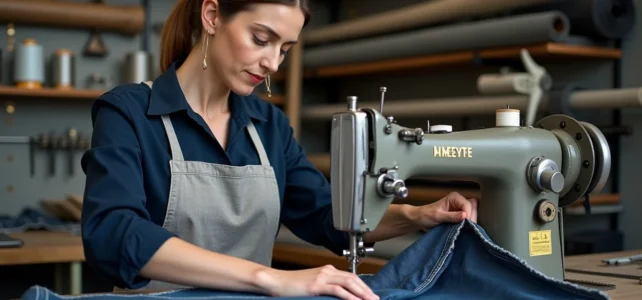
Choosing a machine capable of sewing through multiple layers of denim, oilcloth, or faux leather without jamming raises a measurable question: what technical parameters separate a machine truly suited for heavy fabrics from a model whose marketing promises more than its mechanics deliver? Motor power, presser foot lift height, type of drive, metal or plastic chassis: these criteria can be compared, quantified, and effectively used to sort through the available options.
Motor Power and Metal Chassis: The Data that Distinguish the Ranges
The first objective filter remains the motor power. Consumer-grade machines labeled “heavy duty” often come with a motor whose power is below the threshold necessary for regular use on thick materials. According to the EspritCréatif guide (2026), a professional machine for thick fabrics features a motor of at least 100 W, whereas many family models are significantly below that.
The stitching speed also illustrates the gap. An independent workshop model operates at around 800 to 1,200 stitches per minute, while industrial flatbed machines can reach 5,000 stitches per minute. For home use focused on thickness, aiming for the mid-range avoids frustrations without imposing an industrial investment.
| Criterion | Standard Family Machine | Family “Heavy Duty” | Professional / Semi-Industrial Machine |
|---|---|---|---|
| Motor Power | Low (often below 70 W) | Medium | 100 W and above |
| Chassis | Dominantly Plastic | Mixed (plastic/metal) | Predominantly Metal Mechanism |
| Stitching Speed | Moderate | Moderate to Medium | 800-1,200 pts/min (workshop) up to 5,000 pts/min (industrial) |
| Presser Foot Lift | Limited | Variable by model | High (for thick multilayers) |
| Typical Use for Thicknesses | Occasional, 2 layers of cotton | Single denim, fine faux leather | Leather, canvas, multilayer denim |
This table highlights a point often underestimated: the metal chassis determines the stability of stitching on dense fabrics. A plastic frame vibrates more under strain, which degrades stitch consistency and accelerates mechanical wear.
To delve deeper into the specifics of each range, the choice of a sewing machine for thick fabrics benefits from being guided by these technical criteria rather than solely by the manufacturer’s marketing positioning.
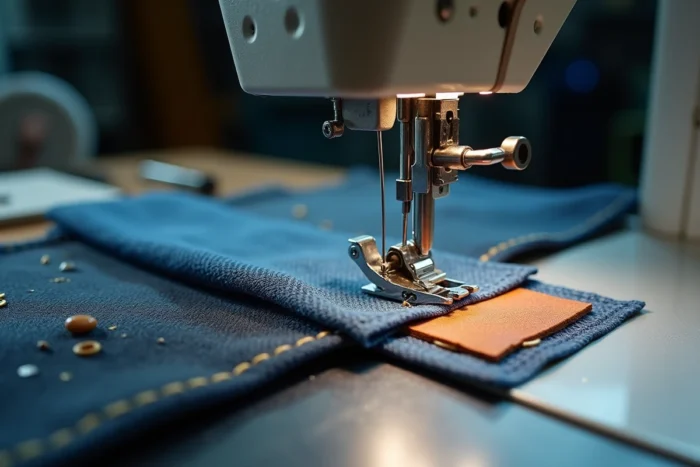
Presser Foot Lift Height: The Overlooked Criterion in Product Sheets
Most comparative guides focus on the motor and available stitches. The presser foot lift height deserves equal attention. This parameter determines the maximum thickness of fabric that the machine can physically accept under the presser foot.
A standard family machine offers a lift of a few millimeters, sufficient for two layers of poplin. To sew through a folded denim hem or assemble multiple layers of upholstery fabric, a significantly higher lift is required. Semi-industrial models and some professional machines incorporate a double presser foot lift system, which provides additional space when the lever is fully engaged.
This criterion does not always appear on online technical sheets. Before making a purchase, checking this data directly with the retailer or in the technical manual of the model remains the most reliable method.
Fabric Feed: Feed Dogs and Dual Feed
On thick and dense fabric, standard feed dogs struggle to move the material forward consistently. The fabric slips, stitches accumulate in the same spot, and the seam puckers. Several technologies address this issue:
- The integrated dual feed (or simultaneous top and bottom feed) synchronizes the movement of the fabric from both sides. Bernina offers this natively on some high-end models, while Juki and Janome also incorporate it in their thickness-oriented references.
- The adaptable dual feed foot attaches to most family machines. It’s an acceptable compromise for occasional projects, but it does not match the consistency of an integrated system.
- Feed dogs with six or seven rows, wider than standard feed dogs, increase the contact surface with the fabric and improve traction on heavy materials.
The type of feed is as important as motor power in the final result. A powerful motor paired with standard feed dogs will produce uneven stitching on thick faux leather.
Brands and Ranges Focused on Thickness: Brother, Juki, Elna, Janome
Among the brands frequently mentioned by specialized technicians, Brother and Juki lead the way for reliability/performance on thick fabrics in advanced home use. Juki, historically positioned in the industrial segment, extends its expertise into domestic models whose mechanics directly inherit from professional flatbed machines.
Elna stands out with models like the Excellence range, some of which can handle leather, a material that most family machines do not tolerate without premature wear. Janome also offers models with a metal chassis and reinforced motor in its mid-range.
On the other hand, entry-level machines labeled “heavy duty” often disappoint on actual thicknesses. The commercial label does not guarantee either motor power or build quality. A baseline budget of around 500 to 600 euros, as recommended by several specialized retailers, allows access to models whose mechanics can support regular use on dense fabrics.
Needles and Settings: Parameters to Adapt Imperatively
No machine, even a powerful one, produces a clean stitch on thick fabric without adapting the consumables. The needle must match the fabric: a standard needle breaks or deflects on thick denim. Specific needles (rounded tip for faux leather, cutting tip for genuine leather) are not interchangeable.
The upper thread tension requires more adjustment than on fine fabrics. Too tight a thread on thick material causes puckering, while too loose a thread creates loops under the fabric. Systematically test on a scrap of the actual fabric before starting to sew remains the only reliable method to calibrate the machine.
The stitch length must also increase: a short stitch on dense fabric perforates the material too many times and weakens the seam instead of reinforcing it.
The most discriminating parameter for a purchase remains the trio of motor power, metal chassis, and presser foot lift height. Needle and tension adjustments can then be adapted project by project, but the basic mechanics cannot be compensated for.