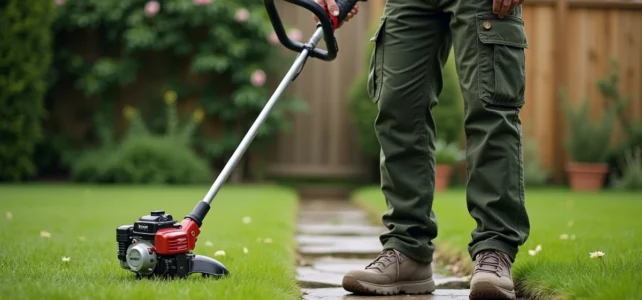
On a sloped terrain with brambles climbing along a low wall, a battery-powered electric trimmer struggles within minutes. The line breaks, the motor struggles, and we eventually put the tool down. It is precisely in these situations that the gas-powered trimmer maintains its place in a garden toolset, provided you choose the right model for the right use.
Two-stroke or four-stroke engine: what it changes in the field
Most guides compare two-stroke and four-stroke engines in terms of price or weight. In practice, the real difference lies elsewhere: low-end torque and fuel management.
A two-stroke engine delivers its power in a more responsive manner, with a quick peak in RPM. It is well-suited for short, intense passes, along an overgrown fence or at the base of trees with woody regrowth. The oil-gas mixture is prepared in advance, which requires a minimum of diligence to avoid clogging the engine.
The four-stroke engine, on the other hand, runs more steadily. It consumes less, produces less vibration, and accepts gasoline without mixing. For long sessions on a large area, this is a concrete advantage. However, a four-stroke is significantly heavier than a two-stroke, which can tire the arms on winding borders where frequent pivoting is necessary.
Detailed comparisons by model and usage can be found on coupebordurethermique.fr, with sheets that help decide between these two types of engines based on the garden’s configuration.
Cutting width and type of line: adapting the tool to actual borders
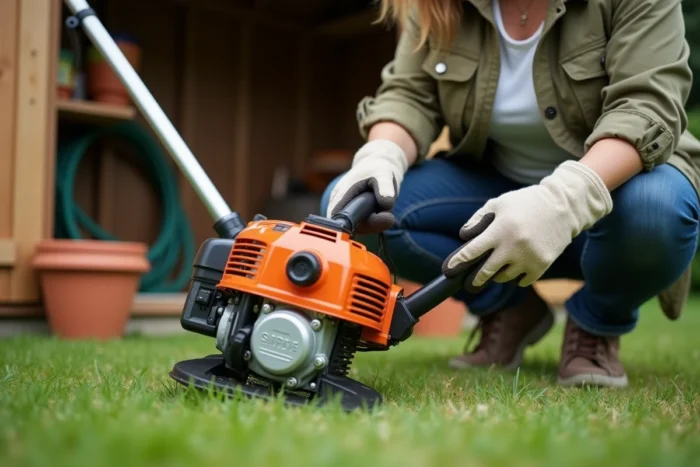
The cutting width directly affects the working speed. A wide head covers more area with each pass, but it becomes cumbersome in narrow zones (between two flower beds, along a tight fence, around shrub bases).
For a garden with well-defined paths and straight borders, a wide cutting head is suitable. If the terrain is fragmented, with corners, rocky areas, or tightly spaced shrubs, a narrower cutting head offers better precision.
The line: diameter and profile make the difference
The cutting line is not a trivial consumable. Its diameter determines its resistance against dense grasses and semi-woody stems. A line that is too thin breaks quickly on tall grasses or tough grasses. A line that is too thick puts more strain on the motor.
- A classic round line is sufficient for regular maintenance of lawn edges and finishing touches after mowing.
- A serrated or star-shaped line better tackles thick grasses and weeds, providing a cleaner cut on resistant stems.
- Plastic blades replace the line on some models and withstand impacts against stone borders better, but they offer a less close cut on fine grass.
The line feeding system also matters. A semi-automatic feed head avoids cutting the motor to adjust the line length, saving time on long border lengths.
Gas-powered trimmer and migration to battery: where to place the cursor
In gardening-landscaping communities, the trend is clear: several professionals report having replaced all their gas-powered trimmers with battery models, keeping the gas-powered ones only for the most powerful tools like heavy brush cutters or poles.
This observation primarily concerns professionals working in residential areas, where noise and emissions pose a concrete problem (condominiums, public contracts with environmental clauses). For an individual with a large property on the outskirts, the question arises differently.
The gas-powered option remains relevant when autonomy and raw power are priorities. On a large area with fallow zones, slopes, or borders along ditches, the battery reaches its endurance limits. Feedback on this point varies by brand and battery generations, but the general trend shows that the gap is narrowing year by year.
Ergonomics and weight of the gas-powered trimmer: often underestimated criteria
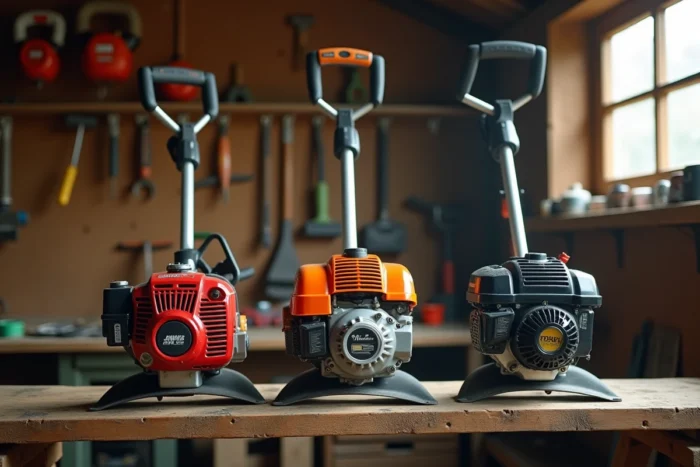
There is much talk about power, but rarely about what happens after an hour of use. The weight of the device, the balance of the machine, and the quality of the harness determine the fatigue felt, especially on sloped terrains.
An adjustable telescopic handle allows you to adapt the working height to your size, avoiding constant bending. The auxiliary handle, when it pivots, facilitates the transition from horizontal position (lawn edge) to vertical position (sculpting the edges of a path).
- The shoulder harness distributes the weight across the torso and frees the arms to guide the cutting head with precision.
- An anti-vibration system on the handle reduces fatigue in the hands and forearms during long sessions.
- A well-balanced gas-powered trimmer can be maneuvered without straining, even during passes lasting several tens of minutes.
Regular maintenance: a parameter of choice
The gas-powered model requires maintenance that the battery does not impose: oil change (for a four-stroke), cleaning the air filter, checking the spark plug, winterizing with fuel drainage. If these steps are neglected, the engine loses performance by the second season.
Before purchasing, it is wise to check the availability of spare parts for the targeted model. A gas trimmer with hard-to-find parts becomes a dead weight at the back of the garage after a few years.
Choosing a gas-powered trimmer is therefore based on a crossover between the actual area to maintain, the nature of the plants at the borders, and the tolerance for mechanical maintenance. On a complex terrain with tall grasses and difficult-to-access areas, it remains an effective tool. In a modest-sized garden with well-defined borders, the battery deserves serious consideration, if only for the comfort of daily use.