Guangzhou is not lacking in tourist guides listing the Canton Tower, Shamian Island, or the Sun Yat-sen Memorial. The problem is that these itineraries all look alike and overlook a ground reality: the city has evolved significantly in recent years, particularly due to the transformation of its industrial wastelands into creative parks open to visitors.
To discover the Cantonese metropolis differently, one can stray from the usual perimeter and dive into neighborhoods where locals live, eat, and create daily.
Converted industrial wastelands in Guangzhou: the creative parks that guides ignore
When looking to visit Guangzhou off the beaten path, the creative parks born from industrial heritage provide the most concrete starting point. These former production sites, transformed into open cultural spaces, function like free micro-neighborhoods where artist studios, independent cafes, and temporary exhibitions mingle.
TIT Creative Park is probably the most developed. Located in a former textile machinery complex dating back to the 1950s, it covers about 75,000 m² and generates an economic activity exceeding one billion RMB annually. It features galleries, design studios, and coworking spaces within buildings whose industrial architecture has been preserved.
Two other sites are worth a visit for their even more confidential character:
- Zinitang Creative Park, a former state sugar factory in the Panyu district of Shawan, retains its original chimneys and equipment. The place hosts bars, workshops, and exhibitions in a raw setting, freely accessible throughout the day.
- Liangcang Xinzao Creative Park, a former grain reserve warehouse for the province, has kept its silos and docks. The atmosphere is calmer, almost contemplative, with a cultural program that changes regularly.
- Other more modest reconversions exist along the Pearl River, such as the park project on the site of the former Guangzhou shipyard, which illustrates the urban policy of replacing secondary industry with tertiary launched in 2007.
These places are rarely mentioned in French-speaking guides, which remain focused on the triptych of Shamian, Yuexiu, Zhujiang New Town. They are more easily spotted via Chinese apps like Dianping or Xiaohongshu.
Local Cantonese cuisine: eat like the locals in Canton
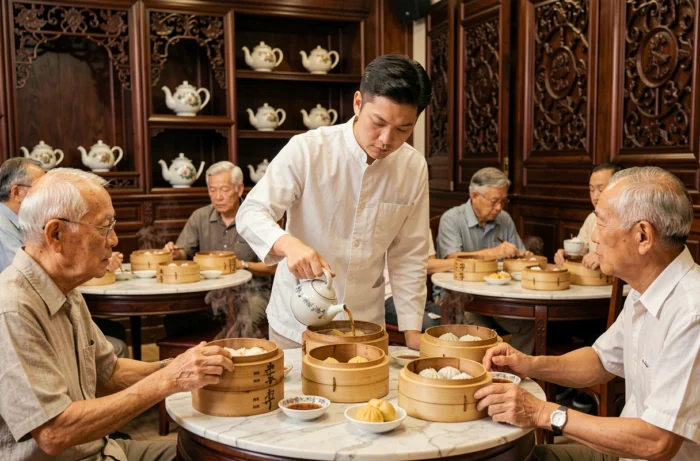
Cantonese gastronomy is not limited to dim sum served in tourist restaurants in Shangxiajiu. To taste the everyday version of this cuisine, one must aim for neighborhood establishments where local families have their breakfast.
The morning yum cha remains the best entry point into Guangzhou’s food culture. You settle into a noisy hall as early as 7 am, tick off dishes on a paper form, and steam carts roll between the tables. Prices are significantly lower than in tourist areas, and the variety of dumplings, marinated chicken feet, or congee far exceeds what is found elsewhere in China.
In the evening, the streets around Qingping market and the small alleys of Liwan host stalls serving wonton mian (wonton noodle soup) and cheung fun (rice rolls). You eat standing up or on plastic stools, for just a few yuan.
Spotting good addresses without reading Mandarin
The language barrier complicates the search for local restaurants. The most reliable on-the-ground tip: observe the queues. In Guangzhou, a crowded restaurant at 11:30 am on a weekday is almost always a good sign. In the residential areas of Haizhu or Liwan, this method works quite consistently.
The Dianping app (the Chinese equivalent of Yelp) also allows filtering by rating and proximity, even without mastering Mandarin, thanks to photos and visual reviews.
Guangzhou at night: nightlife economy and walks along the Pearl River
Guangzhou is among the Chinese cities that are heavily investing in their nightlife economy. The concrete result for travelers: entire neighborhoods remain lively well past midnight, with offerings that go beyond just cocktail bars.
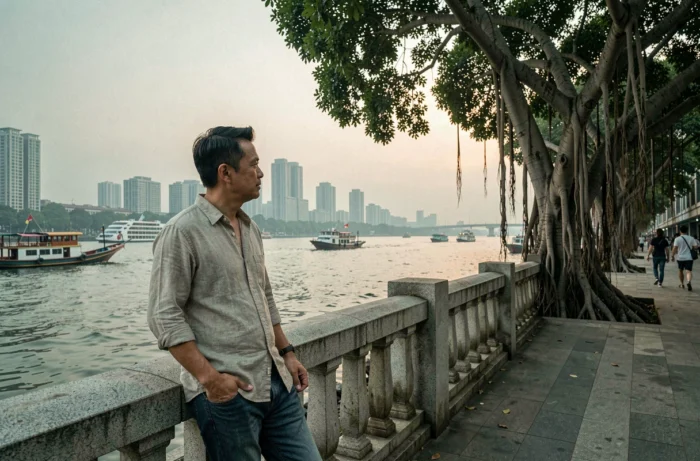
The promenade along the Pearl River between the Haiyin Bridge and Zhujiang New Town offers a panorama of the illuminated towers, but also spontaneous night markets and street food stalls set up along the banks. The atmosphere is family-friendly until around 10 pm, then shifts to a younger crowd.
Guangzhou Metro: getting around at night
The Guangzhou metro closes around 11 pm depending on the lines. After this hour, you switch to Didi (the Chinese equivalent of Uber), whose night rates remain reasonable compared to major European cities. Most of the creative parks mentioned above are accessible by metro during the day, but plan for a return trip by ride-hailing service if you explore at night.
Residential neighborhoods of Guangzhou: Liwan and Haizhu away from the tourist center
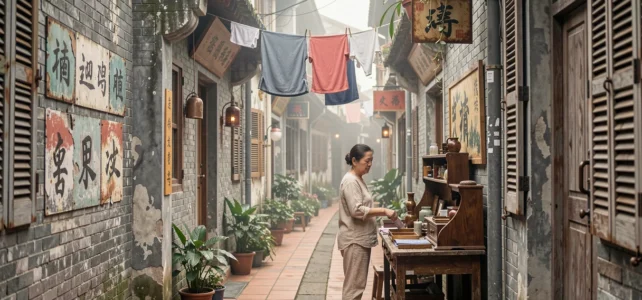
The two most interesting districts for a local immersion are Liwan (the old historical Canton) and Haizhu (south of the Pearl River). Liwan retains narrow alleys lined with gray brick houses, active neighborhood temples, and covered markets where retirees play Chinese chess from the morning.
Haizhu, on the other hand, is home to a growing concentration of independent cafes and small galleries in former industrial buildings. The contrast with Zhujiang New Town, just a few metro stations away, is striking.
You can easily spend half a day in each neighborhood without encountering other foreign travelers. It is precisely here that Guangzhou reveals its character as a vibrant city, far from the glass and steel showcase seen in brochures.
Guangzhou does not need to be reinvented to surprise. It is enough to leave the three or four sites that everyone visits and take the metro to the terminals. The creative parks, neighborhood canteens, and the nighttime banks of the Pearl River compose a parallel city, accessible if one is willing to lose their bearings a little.