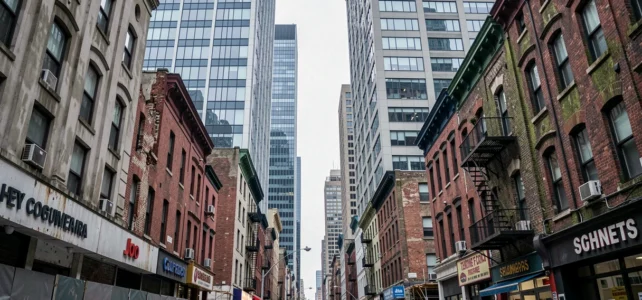
When a new housing development emerges on the edge of a field and an old warehouse is transformed into housing in the city center, these two operations fall under urbanization, but they do not produce the same city at all. Distinguishing these forms helps to understand why some urban areas sprawl while others densify, and what this changes for residents, land, and public budgets.
Urban Sprawl, Densification, and Renewal: Three Very Different Logics
The term “urbanization” encompasses opposing realities. To clarify, one must reason based on what is happening on the ground.
Urban sprawl refers to construction on previously undeveloped land: fields, meadows, forests. It is the classic suburban model, with its commercial zones on the outskirts. The land is artificialized, meaning it loses its ecological function (water infiltration, carbon storage, habitat for wildlife).
Densification, on the other hand, involves building more on already urbanized space. Raising a building, dividing a large plot into two parcels, adding a floor to an existing parking garage: the built perimeter does not expand, but it accommodates more people.
Urban renewal goes further: it recycles already occupied land. An industrial wasteland becomes a mixed-use neighborhood, a dilapidated block is demolished and then rebuilt. This approach limits the consumption of new land while modernizing the existing fabric. To explore in detail the different types of urbanization according to Encherimmo, each logic is described with its own mechanisms.
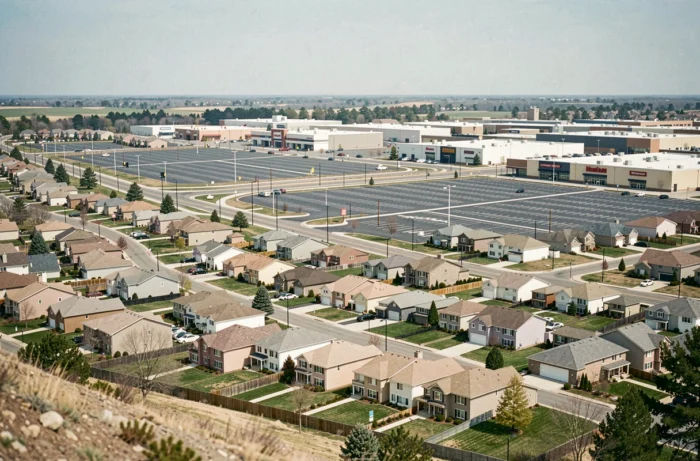
Urbanization and Land Artificialization: What the ZAN Law Changes Concretely
In France, the trajectory of urbanization has just shifted. The Climate and Resilience Law of August 22, 2021, reinforced by the so-called ZAN 2 law of July 20, 2023, sets a legally binding objective: zero net artificialization by 2050.
The intermediate step is equally strict: the consumption of natural, agricultural, and forested spaces must be halved over the period 2021-2031 compared to the previous decade. This is not a pious wish; it is enforceable in court.
Direct Consequence on Building Permits
Do you have land classified as “to be urbanized” in your municipality? If the local urban plan (PLU) or inter-municipal urban plan (PLUi) has not integrated the ZAN trajectory by February 22, 2028, no urban planning authorization can be issued in these areas. The tap is turned off until the document is updated.
This deadline structurally pushes local authorities towards densification and land recycling. Municipalities with wastelands or infill lots (undeveloped parcels surrounded by urban fabric) find themselves at an advantage compared to those whose development relied solely on expansion.
Concrete Impacts on Daily Life Depending on the Type of Urbanization Chosen
The choice between sprawl and densification does not only concern urban planners. It impacts the daily lives of every resident.
- Mobility and Car Dependence: In a sprawling area, the distances between home, work, school, and shops increase. Public transport is rarely profitable, making the car almost mandatory.
- Cost of Public Networks: Every linear meter of road, pipeline, or cable costs the same to install, whether it serves ten homes or one hundred. Densification reduces the cost per resident of these infrastructures.
- Biodiversity and Water Management: Artificialization seals the soil. Rainwater runs off instead of infiltrating, which amplifies flood risks and reduces groundwater recharge.
- Heat Island Effect: Compact forms without sufficient green spaces can overheat in summer, while a suburban sprawl with gardens limits this phenomenon locally, at the cost of significantly higher land consumption.
No model is perfect. Poorly designed densification generates overcrowding and parking tensions. Sprawl, even when controlled, consumes agricultural land whose ecological and food value is permanently lost once the concrete is poured.
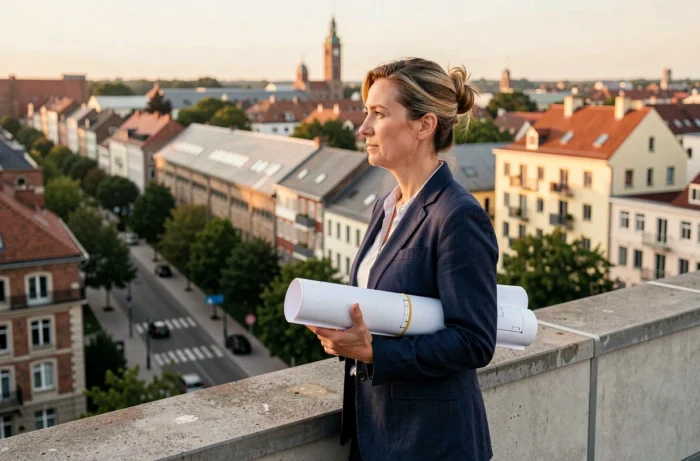
Urban Forms and Biodiversity: An Underestimated Criterion
The Foundation for Research on Biodiversity (FRB), in collaboration with the National Museum of Natural History, conducted a review of knowledge on the links between urban morphologies and biodiversity. The main finding: not all forms of urbanization are equal for wildlife and flora.
A simple gradient from “rural to urban” is not enough to describe reality. Spatial complexity is as important as density. A compact neighborhood with ecological corridors (hedges, grassy strips, green roofs) can host more species than a suburban development where each garden is fenced and mowed short.
What This Implies for Development Projects
Urban planners now have concrete levers to integrate biodiversity into their choices of urban form:
- Maintain green continuities between green spaces, even narrow ones, to allow species movement.
- Prefer vertical expansion to horizontal expansion when existing buildings allow for it structurally.
- Incorporate permeable surfaces (swales, grassed paving) in urban renewal operations.
These technical choices are not a luxury. They determine a city’s ability to manage stormwater, limit heat islands, and maintain an attractive living environment in the long term.
Recent trends in France also show that the consumption of natural spaces has been declining since the mid-2010s. This decline is not only related to regulation: it also reflects an awareness of the real costs of sprawl, both for municipal finances and for ecosystems. The ZAN framework accelerates this shift, but it merely formalizes a movement already initiated by the economic and ecological constraints of the land.