
Your front tires are wearing out faster on one side than the other, or your steering wheel pulls slightly to the right on a straight line. On a Peugeot 208, these symptoms almost always indicate a misalignment issue. Adjusting the alignment on the 208 corrects the toe angle of the wheels so that they roll perfectly parallel to each other, which preserves your tires and the vehicle’s stability.
Toe Angle on the 208: What the Machine Really Measures
When a technician talks about alignment, they are primarily referring to the toe angle. Imagine your two front wheels viewed from above: if their front edges come slightly closer together, it’s called positive toe. If they move apart, it’s negative toe (or outward).
On the Peugeot 208, this angle is adjusted by changing the length of the tie rods, the threaded rods that connect the rack to the steering joints. A turn of the tie rod shifts the angle by a few tenths of a degree. The manufacturer’s tolerance is very tight, and a deviation of just a few tenths is enough to cause abnormal wear.
You will find a detailed explanation of the complete procedure in the guide dedicated to Peugeot 208 alignment adjustment on Armoric Auto, which outlines the specific values and steps for this model.
The complete geometry also includes camber (the vertical tilt of the wheel) and caster (the tilt of the pivot axis). On the 208, camber and caster are not adjustable without specific parts: only the toe can be corrected in a standard workshop. If the diagnosis reveals a camber out of tolerance, it indicates a distorted axle or suspension parts that need to be replaced.
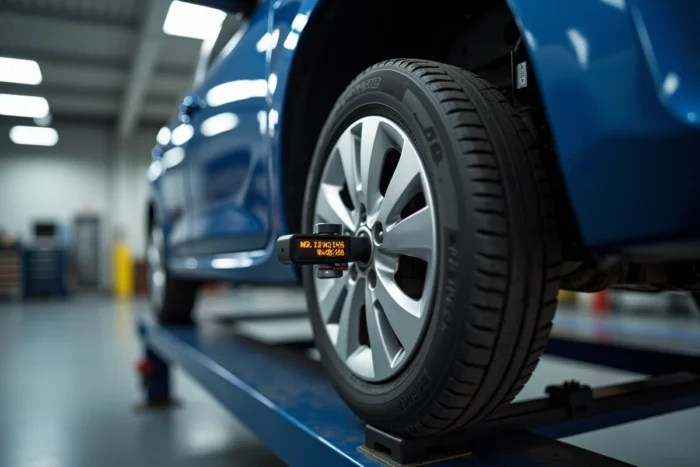
Concrete Signs of Misalignment on Peugeot 208
Have you noticed that your steering wheel is no longer perfectly straight when you drive straight? This is the most common sign. After a poorly executed or delayed alignment, the steering wheel can become misaligned by a few degrees.
Three situations should trigger a geometry check on your 208:
- Asymmetrical tire wear, visible on the inner or outer edge of the tread, especially on the front axle.
- A constant lateral pull, with the vehicle always drifting to the same side on flat roads, without braking.
- A misaligned steering wheel after hitting a curb, a deep pothole, or replacing steering parts.
On forums dedicated to the 208, several owners report a misaligned steering wheel after a visit to the workshop. This issue often arises from an adjustment that was not finalized with the steering wheel locked in the neutral position. A good workshop systematically checks the centering of the steering wheel after each intervention on the toe.
ADAS Recalibration After Geometry Adjustment on Recent 208s
The latest generation Peugeot 208s come equipped with driving aids (lane keeping, emergency braking) that rely on cameras and sensors positioned along the vehicle’s axis. Modifying the toe can distort the reference orientation of these sensors.
Since 2024, workshops have reported an increase in the cost of the intervention whenever the vehicle is equipped with ADAS. The additional cost for recalibrating the sensors is documented to be around 40 to 60 euros on top of the base geometry rate. Ignoring this step does not always trigger a warning light, but the lane-keeping system may intervene incorrectly, correcting the trajectory in the wrong direction.
Before entrusting your 208 to a garage, ensure that they have the appropriate calibration equipment. Quick tire fitting centers are not all equipped for this step, especially on models post-2019.
Choosing the Right Workshop for Your 208’s Alignment
The average price for front and rear alignment on a Peugeot 208 is around 89 euros, with notable variations depending on the engine and region. The average labor time is about one hour.
The choice of workshop is as important as the displayed price. Here’s what distinguishes a reliable intervention from a sloppy adjustment:
- The workshop uses a 3D geometry bench (not just a simple two-point laser), capable of measuring all four wheels simultaneously and comparing them to the manufacturer’s values for your exact version of the 208.
- The technician provides a before/after printout with the recorded measurements. If this document is not offered, ask for it: it proves that the angles have been corrected within tolerances.
- The garage checks the condition of the tie rods, joints, and bushings before making adjustments. Adjusting the toe on worn parts is like trying to straighten a frame on a slanted wall: the adjustment will not hold.
A detail often overlooked: tire pressure must comply with Peugeot’s recommendations at the time of measurement. A tire under-inflated by a few hundredths of a bar alters the ride height and thus the measured angles. A diligent workshop checks and adjusts the pressure before starting the diagnosis.

Frequency and Preventive Maintenance of Alignment on the 208
There is no fixed interval imposed by Peugeot for geometry checks. In practice, a check every 20,000 km or after each significant impact protects your tires and your driving comfort. Replacing shock absorbers, steering joints, or control arm bushings also justifies a systematic check.
Also, consider having the alignment checked when mounting new tires. Installing new tires on a misaligned axle accelerates their wear from the first kilometers, significantly reducing their lifespan.
Alignment is not a one-time operation. Driving conditions (poor roads, repeated bumps, parking against a curb) constantly stress the ground connection elements. On the 208, whose front axle is of the pseudo-McPherson type, the tie rods directly absorb these stresses. Regular monitoring remains the best way to preserve both your tires and your vehicle’s handling.