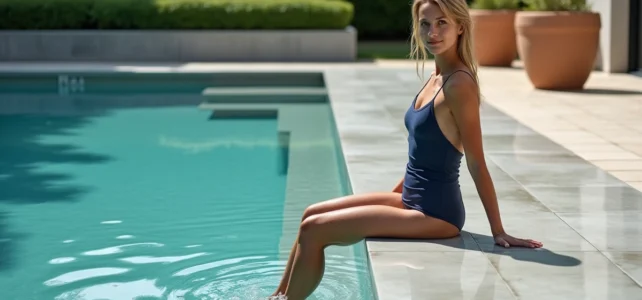
The pool bench is an immersed seat, either built-in or integrated into the shell, whose width determines both postural comfort and the visual balance of the pool. Between a bench that is too narrow, serving only as a step, and an oversized bench that reduces the swimming area, sizing relies on precise technical criteria.
Ergonomics of the immersed seat: how width affects posture
The width of a pool bench is not chosen randomly. It conditions the body’s posture in the water and, by extension, the duration for which one can comfortably sit.
A seat width of 40 cm allows one to sit with a relatively straight back, feet resting on the bottom of the pool or on a lower step. This width corresponds to a waiting or resting position between laps. The body cannot fully relax here, as the body (in the anatomical sense) rests on a reduced surface that concentrates pressure.
Starting from 60 cm, the thigh is supported over a greater length. The center of gravity shifts back, the back can lean against the pool wall, and the posture resembles that of a low chair. It is at this width that the bench transitions from functional use to a real relaxation space.
For lounge use in a semi-reclined position, feedback from architects specializing in outdoor design points to a width of 80 to 100 cm. These proportions are inspired by the seat depth of outdoor sofas, which is around 70 cm, to offer a coherent posture between terrace furniture and the immersed space.
You can discover By Caroline and CO’s advice on this topic to delve deeper into the sizing suitable for each project.
Pool bench width and swimming volume: finding the right ratio
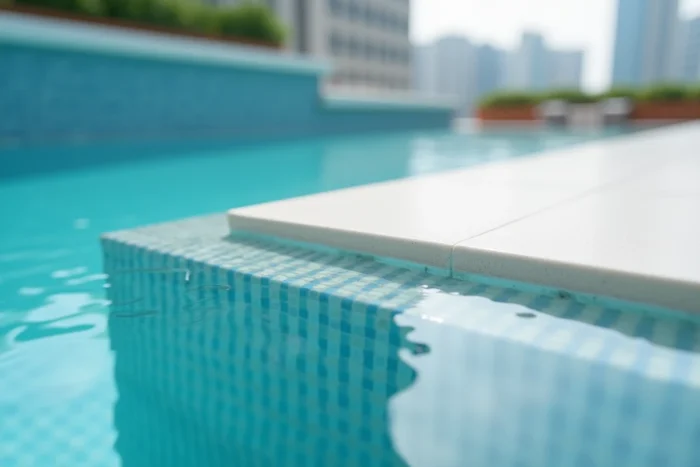
Widening the bench reduces the available surface for swimming. In a standard-sized pool, every centimeter counts. A 100 cm bench across the width of a 4-meter-wide pool cuts a quarter of the swimming area. In a narrow swimming lane, the compromise becomes even tighter.
The ideal width depends on the ratio between the total surface area of the pool and the primary use. Three configurations stand out:
- Family-friendly versatile pool (play, swimming, relaxation): a bench width of 50 to 60 cm offers a good compromise. It allows for comfortable seating without excessively encroaching on the swimming space.
- Relaxation and wellness-oriented pool: a width of 80 to 100 cm transforms the bench into a true immersed lounge. This choice is justified when competitive swimming is not the priority.
- Swimming lane: the bench is limited to 40 cm or may even disappear in favor of a simple access step. Every centimeter is dedicated to swimming length.
A often overlooked point: the bench also modifies hydraulic circulation. A very wide bench creates a stagnant water zone if the return jets are not repositioned. The pool builder must adapt the filtration circuit accordingly.
Water depth on the bench: the parameter that determines comfort
Width alone is not enough to guarantee comfort. The water height above the seat plays a decisive role. An immersed bench under 25 to 35 cm of water places the surface at the level of an adult’s waist when seated, providing a pleasant sensation of immersion without hindering breathing or arm movements.
Too little water (less than 15 cm) and the bench becomes an uncomfortable dry beach, exposed to direct sunlight. Too much water (more than 45 cm) and the seat loses its appeal: one floats more than sits, and children cannot use it safely.
The combination of width and depth creates a complete seating profile. A 60 cm wide bench with 30 cm of water above offers a tested and approved ratio by many owners on specialized forums. For wider models (80-100 cm), a slight incline of the backrest (the pool wall) further improves back support.
Fiberglass or concrete pool: manufacturing constraints
On a fiberglass pool, the bench width is defined at the factory. Standard models generally offer benches of 40 to 60 cm, as the mold is fixed. Modifying this dimension requires changing the pool model, not just adjusting a parameter.
In masonry or shotcrete construction, the freedom is total. The bench can be sized to the nearest centimeter, integrated on one side, in an L-shape, or around the entire perimeter of the pool. This flexibility comes at a cost: the reinforcement, formwork, and waterproofing of a wide bench (over 70 cm) require specific expertise to avoid cracks at the junction between the seat and the wall.
Pool bench and design: how width influences the aesthetics of the pool
A narrow bench blends into the line of the pool and remains discreet. It suits pools with clean lines, like water mirrors, where the flat and continuous surface takes precedence over the immersed furniture.
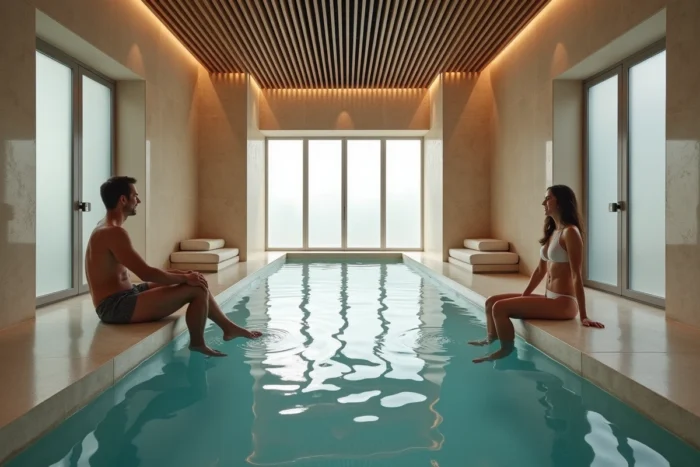
A wide bench becomes a fully-fledged architectural element. It visually segments the pool, creates a contrast between the deep area and the resting area, and can accommodate differentiated finishes (mosaic, natural stone, colored coating). Landscape architects use this visual break to structure the pool area like an outdoor living room, with defined zones.
The choice of coating also influences the perception of width. A light tile on the bench and a dark liner in the pool accentuate the separation. A uniform coating, on the other hand, integrates the bench into the pool and gives the impression of a larger surface.
The range of 40 to 60 cm remains the standard for a bench that combines seating comfort and preservation of the swimming space. Moving to 80-100 cm is justified only when the pool is large enough and relaxation takes precedence over swimming. In any case, it is the combination of width and water depth, not width alone, that determines whether the bench will be truly used or merely decorative.