
The Peugeot 305 GTI 16 has never appeared in any official catalog of the lion brand. This model, which can sometimes be found in classifieds or on enthusiast forums, is the result of artisanal modifications made in garages, not from a production line in Sochaux. Understanding where this phantom name comes from is to dive into the concrete mechanics of engine swaps and into the French youngtimer culture.
XU Engine Swap in a 305: Why It Works
When you open the hood of a 305, you discover an engine compartment designed around the XU family of blocks, the same architecture used in the 205, 309, and 405. The engine mounts, front crossmember, and gearbox placement share a very similar geometry from one generation to the next.
It is this mechanical compatibility that inspired amateur tuners as early as the 2010s. Fitting an XU9JA 1.9 from a 205 GTI or a MI16 16-valve engine into a 305 does not require heavy modifications to the shell. Work is done on adapting the wiring harness, connecting the exhaust, and sometimes reinforcing the suspension, but the base can accept the graft without major structural surgery.
To learn everything about the Peugeot 305 GTI 16, we see that this designation actually covers two distinct families of conversions: those based on the 1.9 8-valve engines from the 205/309 GTI, and those that push the project up to the 1.9 or 2.0 16-valve MI16, which is significantly more complex to wire.
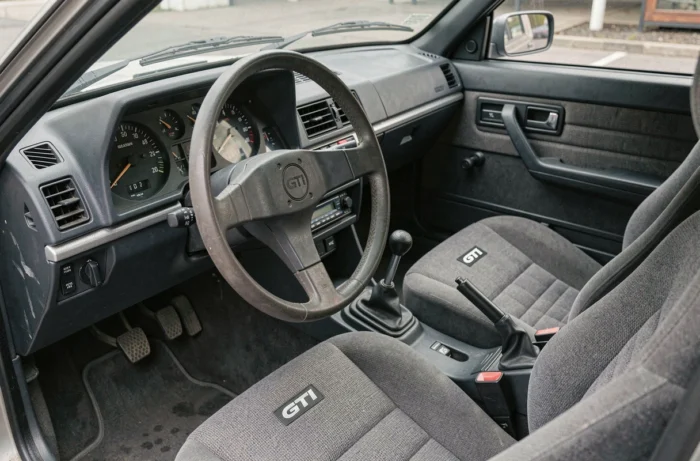
Peugeot 305 GTX Series: The Only True Sports Ancestor
Before discussing modifications, we must look at what Peugeot actually offered in a sporty version of the 305. The 305 GTX, unveiled at the 1984 Paris Motor Show, represents the official peak of the range. It featured a 1.9 atmospheric 8-valve engine, derived from the XU9 block, with modest power levels compared to the GTIs of the time.
The GTX suffered from a timing issue. In 1984, the 205 GTI was capturing all the media and commercial attention. The Peugeot stand at the show was dominated by the city car, the Turbo 16, and the Quasar concept car. The 305, a sober family sedan designed by Pininfarina, took a back seat despite its road qualities.
Its chassis, however, offered a healthy and predictable behavior thanks to a contained weight. The 305 weighed less than a ton in its base versions. This correct power-to-weight ratio explains why enthusiasts chose this shell over a 309 or 405 for their swap projects: a lightweight body and a well-sized front end to accommodate more power.
Peugeot 305 V6 Prototype: The Forgotten Link to Competition
Shortly after the launch of the 305 in 1977, Peugeot worked on a V6 prototype intended to explore the platform’s potential in competition. This project used the famous PRV block (Peugeot-Renault-Volvo), an engine found in much higher-end vehicles like the 604.
The 305 V6 prototype never went beyond the experimental stage. Reports vary on the exact reasons for its abandonment: budget constraints, a shift towards the 205 Turbo 16 program, or simply the incompatibility between the compact platform and a bulky V6. What remains factual is that the 305 served as a laboratory before the 205 T16 took over in rallying.
This missing link between the sensible sedan and the Group B racing beast fascinates brand historians. The PRV V6 in the cramped compartment of a 305 posed cooling and mass balance problems that Peugeot would later solve with the rear mid-engine architecture of the T16.
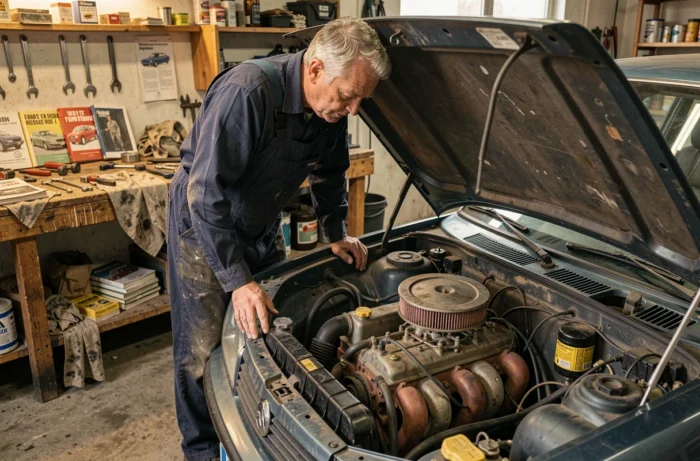
Finding and Ensuring Reliability of a Prepared 305: Checkpoints
In the current youngtimer market, a 305 with a GTI or MI16 engine swap is priced within a very variable range depending on the quality of the installation. The price depends less on the shell than on the rigor of the preparation. Here’s what to check first on this type of project:
- The consistency of the wiring harness: a poorly wired MI16 swap generates intermittent failures that are difficult to diagnose, especially regarding injection and ignition management.
- The condition of the engine mounts and crossmember: even if the geometry is compatible, worn or improvised mounts with unsuitable parts create vibrations and accelerate transmission wear.
- The sizing of the braking system: upgrading from a stock engine to a significantly more powerful block without upgrading the front discs and calipers is a common mistake in these installations.
- The registration and homologation: in France, a change of engine must theoretically be declared. Most “GTI 16” 305s circulate with an original registration, which can pose problems during a technical inspection or resale.
A clean installation is recognized by the attention to peripheral details, not just the engine itself. Replaced hoses, resized radiator, new bushings: these elements reveal the level of demand from the tuner.
Spare Parts for XU Engine on 305
Parts supply remains an advantage of the XU family. Gaskets, valves, timing kits, and rings can still be found from specialized suppliers. The shared mechanical base with millions of 205, 309, 405, and BX guarantees availability that other older engines no longer offer.
The Peugeot 305 GTI 16, even though it never existed as an official model, embodies a passion-driven approach that refuses to let an underestimated platform die. It is a mechanical object built by those who drive it, with the qualities and limitations that this implies.