The French market for used boats shows a slight contraction, with 57,595 transactions recorded between September 2025 and August 2026, representing a decline of about 3.8% year-on-year according to Boatindustry. The new segment is declining more sharply, which mechanically directs some buyers towards used boats.
In this context, steel sailboats hold a special place: robust, repairable, designed for offshore sailing, they attract a buyer profile looking for a cruising boat rather than a racing platform.
Corrosion and residual thickness: what makes or breaks a used steel sailboat
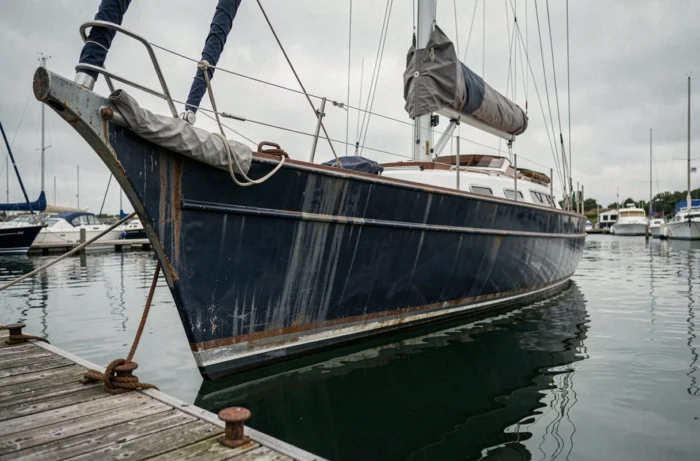
On a polyester sailboat, osmotic blisters are inspected. On a steel sailboat, everything hinges on corrosion. The residual thickness of the hull plates determines the boat’s medium-term viability, and this data cannot be guessed by the naked eye.
An ultrasonic inspection, carried out by a maritime expert, allows for measuring the thickness at several dozen points on the hull and deck. Critical areas concentrate around the waterline, through-hulls, and keel welds. A steel sailboat whose plates fall below the safety threshold requires costly re-plating, sometimes exceeding the purchase price itself.
Field reports vary on the lifespan of a well-maintained hull treatment. Some owners report rust reappearing after a few years despite complete sandblasting, while others sail for more than ten years without heavy intervention. The quality of the initial preparation (SA 2.5 sandblasting, sufficient layers of epoxy primer) weighs as much as the type of steel used.
Before any visit, it is advisable to check the available listings for a steel sailboat for sale on Angel Sport to compare features and prices in the current market.

Price gap between the Mediterranean and Atlantic: where to buy a steel sailboat
The geographical location of the boat significantly alters the budget. Used boats are negotiated 15 to 30% more expensive in the Mediterranean than in Brittany or along the Atlantic coast, according to an analysis by Bateau.click updated at the end of August 2026. Demand remains stronger there, and the sailing season is longer (April to October), which supports resale prices.
For a buyer, this disparity opens a concrete avenue. A steel sailboat moored in Brittany or on the Channel coasts costs less to purchase, but one must factor in the delivery if the sailing plan aims for the Mediterranean. The journey by sea (via the Bay of Biscay and Gibraltar) represents several weeks and a significant budget for fuel, insurance, and possibly crew.
On the other hand, buying directly in the intended sailing area avoids these hidden costs and allows for inspecting the boat in its real environment. A sailboat that has spent twenty years in the Mediterranean has not faced the same stresses (tidal currents, salinity, winter conditions) as a boat stationed in the North Sea.
The weight of the home port in the annual budget
Beyond the purchase price, the marina slip constitutes a recurring expense. Mediterranean ports charge significantly higher rates, and waiting lists can extend for several years in the most sought-after areas. A buyer aiming for a long steel sailboat (over twelve meters) must check the availability of a slip before signing.
Inspection points specific to steel construction
Beyond corrosion, a used steel sailboat presents particularities that buyers accustomed to polyester or aluminum may not always know. Here are the key areas to examine:
- The condition of sacrificial anodes: their wear indicates the actual cathodic protection of the boat. Completely consumed anodes indicate a maintenance deficiency or a galvanic current issue related to the port environment.
- The structural welds, particularly at the hull-deck junctions and mast reinforcements: on a boat several decades old, micro-cracks may appear without visible external signs, especially if the sailboat has sailed in rough seas.
- The electrical circuit and grounding: on a metal hull, a defect in electrical insulation causes accelerated electrolytic corrosion. A multimeter check between the hull and the onboard circuit can detect current leaks.
- The interior insulation: a poorly insulated steel sailboat generates permanent condensation that degrades the interior and masks emerging rust beneath the bulkheads.

Amateur-built steel sailboats vs. professional shipyard: two distinct markets
The market for used steel sailboats is divided into two categories that do not follow the same pricing logic or risks.
Shipyard constructions (Nordia, Trintella, Garcia for aluminum but with steel equivalents from Dutch or German shipyards) offer manufacturing traceability, plans validated by a naval architect, and often a documented maintenance history. Their value remains relatively stable, as demand for these units exceeds the available supply.
Amateur constructions represent a significant share of steel sailboats on the market. Their entry price is significantly lower, sometimes half that of an equivalent shipyard boat in size. The trade-off: the quality of construction varies considerably from boat to boat. Some amateurs have worked rigorously on recognized plans (Bruce Roberts, Reinke), while others have improvised structural modifications without load calculations.
The available data do not allow for concluding that an amateur construction is systematically less reliable. Ultrasonic expertise remains the only objective arbiter. A well-built and maintained amateur boat can offer an excellent ratio between purchase price and offshore capability.
Check for certification and registration
A sailboat built by an amateur must have a certificate of conformity or CE marking depending on its launch date. The absence of this document complicates registration and may block future resale. This administrative point, often overlooked during purchase, deserves verification before any negotiation.
The market for used steel sailboats rewards methodical buyers. Comparing prices between maritime fronts, requiring a thickness check, distinguishing between amateur and professional construction: these steps take time, but they separate a good deal from a financial pitfall.